8/3-4/93
Version 1.0
K.A. LaBEL
CODE 735.1
NASA/GSFC
Greenbelt, MD 20771
I. INTRODUCTION
The objective of this study was to determine the threshold linear energy transfers (LETs) and cross-sections for single event upset (SEU) and latchup (SEL) due to heavy ions for devices being considered for usage by NASA's Far Ultraviolet Spectroscopic Explorer (FUSE) program. LET threshold is defined as the minimum LET to cause an effect at a particle fluence of 1E7 ions/cm2.
II. TEST SAMPLES
Relevant characteristics of the 1553 bipolar devices are summarized in the following table:
Part Number   Manufacturer       Date/Lot    Part    Comment
                                 Code        Type

63125         UTMC               9250/9315   15V    Hi-rel
                                                    version
63125         ILC-DDC            ???         15V
CT1487D       Marconi/CTI        9316        15V    Samples
                                                    arrived late
3411          Aeroflex Labs      A6762S      15V
1500          National Hybrids   9328        15V
FC1553621     STC                            15V    Device Not
                                                    Available
                                                    for Testing
CT2521        Marconi/CTI        9249        5V
63147         Microrel (UTMC)    ???         5V     Hi-rel
                                                    version
63147/63148   ILC-DDC            9301        5V     Device did
                                                    not work in
                                                    test setup
                                                    due to
                                                    transformer
                                                    mismatch
ARX3453       Aeroflex Labs      ???         5V
1529          National Hybrids   9329        5V
FC1553921     STC                ???         5V
Relevant characteristics of the other devices under test (DUTs) are summarized in the following table:
Part Number   Manufacturer       Date/Lot    Part    Comment
                                 Code        Type

22V10         Atmel              ???         CMOS
                                             PAL
IDA07318      HP                 ???         ECL     SEL only
                                             Laser
                                             Driver
Sample devices were delidded in order to accommodate beam penetration limits of the test facility. The devices are packaged in 32 pin Dual In-line Packages (DIP).
III. TEST TECHNIQUES AND SETUP
A. Facility Usage
The test facility used was the Brookhaven National Laboratories (BNL) Single Event Upset Test Facility (SEUTF). This setup utilizes a Tandem Van De Graaff accelerator suitable for providing varying ions and energies for SEU testing. The test devices are mounted on a device-under-test (DUT) board inside a vacuum chamber.
The SEUTF uses a computer-driven monitor and control program to provide a user-friendly interface for running the experiments. Additionally, support was provided by engineers working for Dr. Stassinopoulos under the consortium that runs the SEUTF. Hard copies of the test data and graphs were also made available.
All testing was performed at a (nominal) 25° C.
B. Ion Beam Usage
The following table summarizes the ions used for testing.
ION  ATOMIC #  ENERGY, MeV    LET, MeV*cm2/mg at 0 deg.

F    19        142            3.35
Cl   35        208            11.5
Ni   58        270            26.5
I    197       321            59.7
Additional effective LET values were attained by varying the angle of incidence of the ion beam to the device. The values used in this test ranged from 3.35 to 80. Note: not all ions were used for all DUTs. All LET values discussed further are in MeV*cm2/mg.
C. Test method for 1553B Transceivers
Known data is sent from the Bus Controller or BC (inside of a PC) on one side of the 1553 bus to one of the DUTs (aka Remote Terminal or RT). The 1553 protocol performs message error checking on the transfers (parity errors, incorrect addresses). The data inside the receiving RT is then transferred to its other side and transmitted back to the PC. Protocol error checking is performed here, as well. All errors are logged by the PC.
A message error cross section is determined per test run (N message errors/Fluence). As one might expect, beam flux profile and DUT utilization or bus data rate will affect the error cross section. Beam fluxes were held between 1E4 and 2E5 particles/cm2/sec. Data was transmitted by both BC and RT at a 471 kbit/s rate, thus an effective 94% bus utilization was achieved. This approximates a worst case test. Error cross section would be expected to scale linearly with data rate.
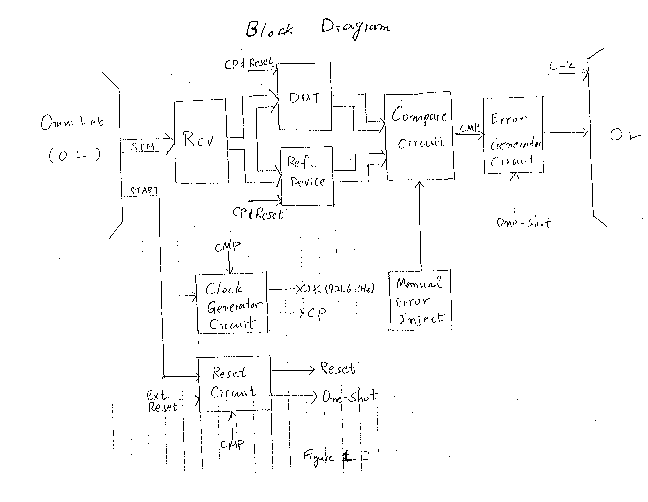
Figure 1 illustrates a block diagram of the test hardware. Sel was monitored for via computer-controlled power supplies.
D. Test method for ATMEL 22V10 PAL
Figure 2 is a block diagram of the test system. Each PAL was programmed with some typical logic circuits (see Appendix A for listing). Test inputs were sent from the PC-based Omnilab to the DUT and a reference device and the outputs compared for errors. These errors were monitored for by the Omnilab.
Test circuitry ran as nominally 1.0 MHz. SEL was monitored for via computer-controlled power supplies.
E. Test method for HP IDA 07318
An SEL setup was built by biasing control inputs and using an oscillating data input. SEL was monitored for via computer-controlled power supplies.
IV. TEST RESULTS
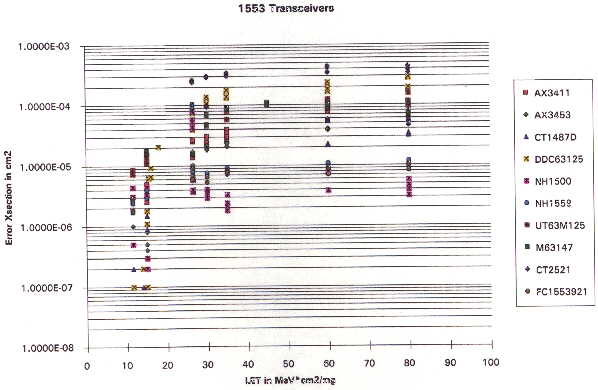
No SEL was seen on any test run for any DUT with a maximum LET value of 80. SEU test results for the 1553 transceivers are shown in Figure 3. Please remember that cross sections are ERROR cross sections and not device cross sections. Each 1553 transceiver is discussed briefly in the table below.
| DEVICE | LETth (+ if threshold not reached, cross section at lowest LET value) |
Max. Error Cross Section in cm2 (LET=80) |
Comments |
|---|---|---|---|
| Aeroflex AX3411 |
< 11.5 (2E-6) | 3E-4 | LETth and Sat. Cross Section NOT reached during test |
| Aeroflex AX3453 |
< 11.5 (1E-6) | 5E-5 | LETth and Sat. Cross Section NOT reached during test |
| Marconi CT1487D |
11.5 | 5.5E-5 | - |
| ILC DDC DDC63125 |
14.0 | 3E-4 | - |
| Nat Hybrids NH1500 |
< 11.5 (4E-6) | 6E-6 | Cross Sections are sketchy due to beam being unable to cover all dies in hybrid |
| Nat Hybrids NH1559 |
< 11.5 (2.5E-6) | 1.5E-5 | - |
| UTMC UT63M125 |
< 11.5 (8E-6) | 1.5E-4 | Previous test (6/93) had shown destructive SEL. This is being investigated further. |
| UTMC M63147 |
< 11.5 (3E-6) | 1E-4 | - |
| Marconi CT2521 |
< 26.5 (2.5E-4) | 4.5E-4 | Both samples of DUT "failed" before Ion was changed to Cl. Failure is being investigated further. |
| STC FC1553921 |
< 26.5 (1E-5) | 1E-5 | Both samples of DUT "failed" before Ion was changed to Cl. Failure is being investigated further. |
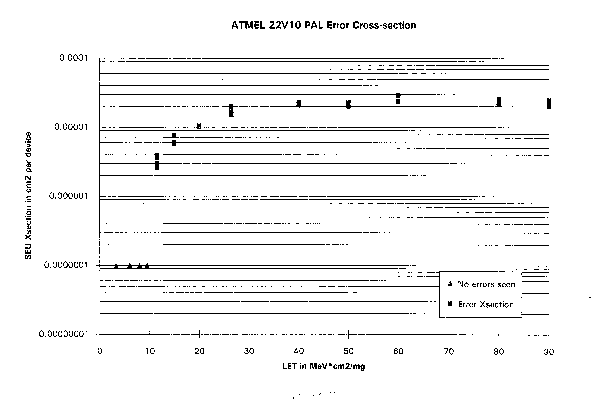
Figure 4 represents the SEU cross section data for the ATMEL 22V10 PAL. LETth is between 9 and 11.5 with a maximum cross section of < 3E-4 cm2 per device.
No SEL was seen for any tested LT value (up to 80) for the HP IDA07318.
V. CONCLUSIONS AND RECOMMENDATIONS
All of the 1553 transceivers showed some susceptibility to SEUs, but none to SEL. The manifestation of SEUs on the transceivers appear as failed messages capable of being handled by the 1553 protocol with proper system design.
The SEU susceptibility of teh transceivers varied from moderately hard to apparently soft. The DDC63125 and CTI1487D have high enough LETth's to expect no proton-induced SEUs during a mission lifetime. All other transceiver device types may be susceptible to proton-induced SEUs. Detailed discussion of each transceiver is available by contacting the author of this report.
The bottom-line with the transceivers is if your system can handle occasional message errors, then they are acceptable from SEU concerns. Total dose testing and, in some cases where the LETth has not been determined, further SEU testing is recommended.
The ATMEL 22V10 PAL is acceptable for usage where an occasional transient error is admissible. Again no SEL was seen during testing.
The criteria for acceptance of the HP IDA07318 was no SEL. With this in mind, this device is acceptable for usage.
V. ACKNOWLEDGEMENTS
The author would like to acknowledge gratefully: the test team members, BNL staff, JPL involvement, NRL, Martin Marrietta, UTMC, Marconi, DDC, Aeroflex, National Hybrids, and STC.
     'PAL 22V10 Test
     At BNL Dec. 3, 1993'

     PAL device 'P22V10';

"Inputs
     clk       pin 1;
     OUTENB    pin 2;

"Output

 Q3,Q2,Q1,Q0   pin 21,20,19,18;
 Q3,Q2,Q1,Q0   istype 'reg';
 Q9,Q8,Q7,Q6,Q5,Q4                pin 23,22,17,16,15,14;
 I9,I8,I7,I6,I5,I4,I3,I2,I1,I0    pin 13,11,10,9,8,7,6,5,4,3;

"State Register assignment
  sreg    =[ Q3,Q2,Q1,Q0 ];
  Combout = [ Q9,Q8,Q7,Q6,Q5,Q4 ];
  InpVec  = [I9,I8,I6,I5,I4,I3,I2,I1,I0];
  X = .x.;

Equations
        sreg.ar   = (!OUTENB);
        sreg.clk = clk;

        Q9 = OUTENB & ((I0 & I1) $ (I2 & I3));
        Q8 = OUTENB & (!I0 & !I3);
        Q7 = OUTENB & (I4 # (!I5 & I6));
        Q6 = OUTENB & ((!I0 $ I1) & !I7);
        Q5 = OUTENB & (!I8 & (I4 # !I2));
        Q4 = OUTENB & (I5 # (I6 & I7));
        Q3 = (Q5 & !I2) # (Q4 & I8);
        Q2 = !Q4 & (Q7 # I5);
        Q1 = I3 & I0 & (I5 # I7);
        Q0 = I3 # I4 # (I6 & I2) # I5 & (I9 # I1);

test_vectors
         ([clk, OUTENB, InpVec] -> [ Combout, sreg ])
         [.c.,  0,       X ] -> [ ^h0, ^h0];
         [.c.,  1,       ^h0 ] -> [ ^h16, ^h8];
         [.c.,  1,       ^h100 ] -> [ &h14, ^h0];
         [.c.,  1,       ^h3ff ] -> [ ^h9, ^hb];

end


......... & - AND
......... $ - XOR
......... # - OR
......... ! - NOT
Home
Last Revised: February 03, 2010
Digital Engineering Institute
Web Grunt: Richard Katz