3-Jan-97
Heavy ion single event effect (SEE) testing was performed at BNL on June 12, 1996 on the following device:
MFR      Device   Part #         Date Code   Other Markings   Vcc
Xilinx   FPGA     3090APG175-6   9512                         5V
Additional device information is as follows:
                                           Configuration
Device   Package        Process      Epi   RAM in bits     Usable Gates/ Test Design
Xilinx   175-pin CPGA   0.8um CMOS   ???   64160/8026      6000/166 of 320 CLBs (51%)
The largest member of this family is:
- Xilinx - XC3195 - 9000 usable gates
This device is a RAM-based programmable device with schematic configurations downloaded via an EPROM external to the device.
Test modes used were:
- Dynamic: While being irradiated, a 1 Mhz clock is fed through 16 8-bit counters with 8
each on separate busses as well as four 8-bit shift registers and eight 8-bit flip-flops
for control lines. Shift register output is monitored on digital scope. Appendix A shows device utilization (51%).
Ions used for testing were:
   Ion     Energy    LET at normal incidence
   F-19    140 MeV   3.38 MeV*cm2/mg
   Si-28   186 MeV   7.88 MeV*cm2/mg
   Cl-35   208 MeV   11.4 MeV*cm2/mg
   Ni-28   266 MeV   26.5 MeV*cm2/mg
Intermediate LET values were gained by varying the device to the beam angle of incidence.
Types of Errors
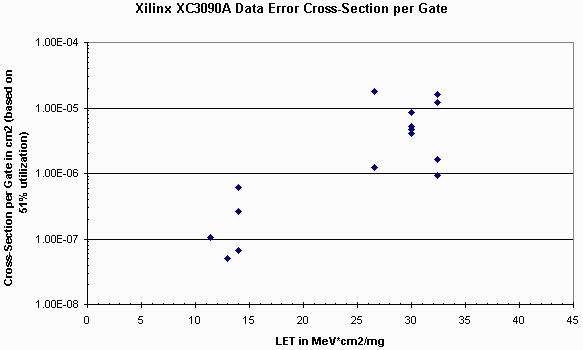
Output bits in error are kept count of as DATA errors (i.e., SEU in shift register,
counter or I/O). If device output no longer appears or a dramatic shift in the output is
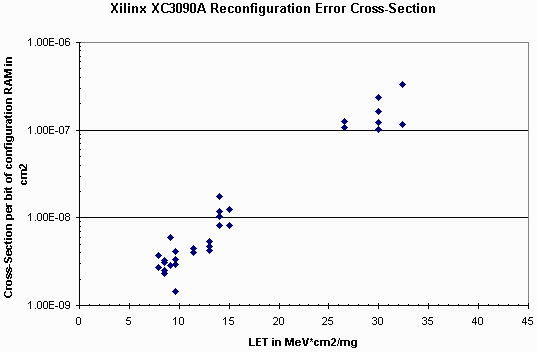
recognized, a device reconfiguration (i.e., SEU in configuration RAM portion of the
device) has occurred. This latter error is dubbed a Single Event Reconfiguration (SER).
Data errors
Data errors were observed on the XC3090 (Figure 1)
device. The LETth is between 8 and 10. This is to be compared with the previously reported
LETth of 4 to 7 on April 1996 test trip.
SER
SERs were observed on the XC3090 (Figure 2).
The LETth is between 4 and 7. This is to consistent with the previously reported LETth of
4 to 7 on April 1996 test trip.
SEL
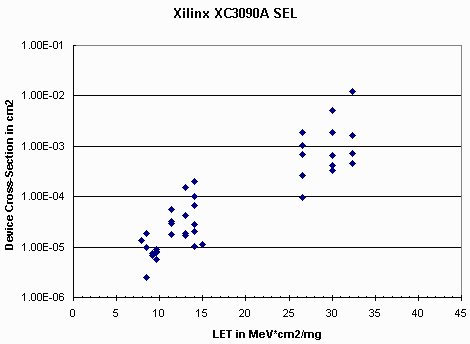
Latchup was observed as seen in (Figure 3).
The LETth is between 4 and 7. This is to consistent with the previously reported LETth of
4 to 7 on April 1996 test trip.
Nominal operating Icc was around 22.4 mA. SEL currents were between 50-75 mA.
It should be noted it is possible to get a high current condition resembling SEL. This condition is theorized to be either a form of snapback or a reconfiguration of an internal (blind to the user circuitry) node causing two output drivers to be in conflict. To the best of our test ability, this was not observed.
These devices are not recommended for usage in most space missions. They would be grouped in GSFC's category 4 rating: Not recommended for general usage, but may be used as long as extensive SEU mitigation and SEL mitigation techniques be employed.
Home
Last Revised: February 03, 2010
Digital Engineering Institute
Web Grunt: Richard Katz