The objective of this study was to determine the threshold linear energy transfers (LETths) and cross-sections (sigma) for single event upset (SEU) and single event latchup (SEL) due to heavy ions. LETth is defined as the maximum LET at which no errors are seen at a fluence of 1E7 particles/cm2. SEU LETth is defined as the minimum LET value to cause an effect at a fluence of 1E7 particles/cm2. SEL LETth is defined as the maximum LET value at which no latchup occurs at a fluence of 1E7 particles/cm2. The saturation cross section (sigmasat) of the device is the point at which the cross section curve becomes asymptotic.
Heavy ion single event effect (SEE) testing was performed at Brookhaven National Laboratories' twin Tandem van de Graaff accelerator on May 13-16, 1997. Test sample information follows:
| Device | Function | MFR | Lot/Date Code |
|---|---|---|---|
| ESN (Essential Services Node) | Embedded Data Handling System | Honeywell | - |
| 7805LPRP | 16-bit ADC | SEI/??? | 9435 |
| CLAy-31 | RAM-based FPGA | NSC | F006E0920 |
| FUGA15 | CCD Driver | Sira | - |
| AS58C1001SF-15EH | 1Mbit EEPROM | Hitachi | 9646 |
| 1840RP | 16-channel Analog MUX | SEI/??? | - |
| MG80486DX266 | Microprocessor | Intel | 9451 |
ESN and MG80486DX266 results are discussed separately.
A. Facility Usage
Testing was performed at the Brookhaven National Laboratories (BNL) Single Event Upset Test Facility (SEUTF). This setup utilizes a dual Tandem Van De Graaff accelerator suitable for providing ions and energies for SEU testing. The test devices are mounted on a device-under-test (DUT) board inside a vacuum chamber. The SEUTF uses a computer-driven monitor and control program to provide a user-friendly interface for running the experiments. Hard copies of the test data and graphs are also made available.
B. Test Hardware, Software and Control
Test hardware, software, etc... consisted of a DUT board placed in the test chamber, six feet of twisted pair ribbon cable, and a PC-based VXI test system. The test system provides patterns to the test boards and captures output when errors occur. The system is capable of controlling the entire test setup, error counters, power supplies, and waveform generators as well as the BNL computer via an IEEE 488 bus.
C. Device Test Procedure
The test procedure was device-specific, although all tests were dynamic in nature, meaning that the devices were operating during the test as they would in a spacecraft application. Generally, power and stimulus were first supplied to the device, which functioned while exposed to the ion beam. During a test run, outputs from the device were monitored for SEUs, and power supply currents were monitored for SEL, until either fluence was reached or SEL occurred. In the case of a device latchup, power and beam to the device were terminated. Otherwise, error counts were logged to the hard drive. Two to three samples are typically used for testing to gain statistical validity. All DUTs were tested at room temperature.
- 7805LPRP
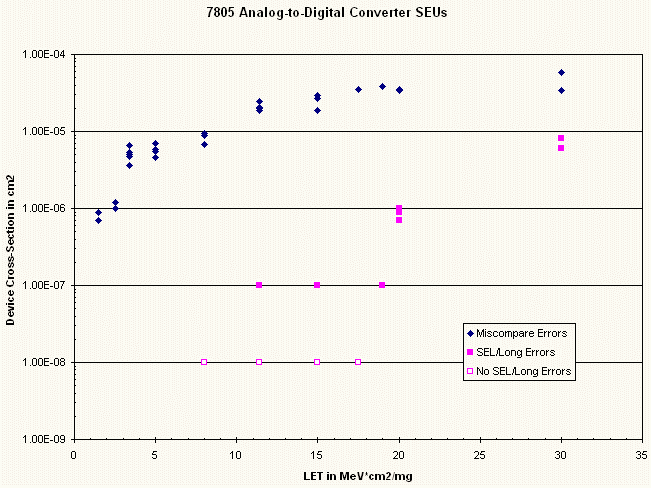
The 7805 is a 16-bit Analog-to-Digital Converter (ADC) from SEI. It includes an older version of SEI's proprietary LPTTM circuit design to stop and recover from destructive/high-current latchup. The 10 most significant bits were monitored, for a device resolution of 4.8 mV out of 5 V. A static input of 4.6 V was used; output miscompares with a reference device were counted as SEUs, along with "long errors" (of ~ 33ms, which were actually SELs that were cleared by the LPTTM). Operating frequency was 40 kHz.
- CLAy-31
The CLAy-31 is a RAM-Programmable FPGA. It was programmed with a 3022-stage shift register for testing, using 3022 out of 3136 possible registers (96% device utilization). The device was retested to explore current jumps detected during previous testing. Operating frequency was 1 MHz.
- FUGA15
The FUGA15 is a CCD MOSFET driver. It was tested for latchup only.
- AS58C1001SF-15EH
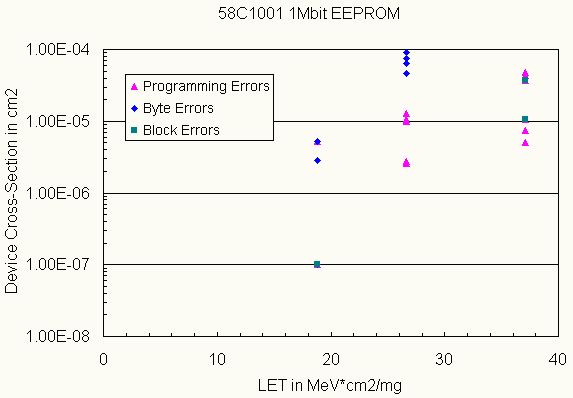
The 58C1001 is a 1M (32k x 8) EEPROM. The device was tested in two modes:
- static - device is pre-loaded with data, and checked after irradiation
- write/page - device is erased prior to irradiation, and programmed during
irradiation
The test pattern was a checkerboard. Bytes in error and control errors (block errors) were monitored.
- 1840RP
The 1840 is a 16-channel analog MUX. During testing, a +5 V signal is applied to the
input, and each of the 16 channels is selected at a frequency of 390.6 Hz revolving rate,
with output compared to a reference device. A window comparator monitored for SEUs, with a
± 10% margin (± 0.5 V in this case). SEUs were binned by duration:
- short - < 10 us
- medium - 10 us to 100 us
- long - > 10 us
C. Test Procedure
Ions used for testing were:
| Ion | Energy (MeV) | LET, MeV*cm2/mg at 0° |
|---|---|---|
| F-19 | 140 | 3.38 |
| Si-28 | 186 | 7.88 |
| Cl-35 | 206 | 11.4 |
| Ti-48 | 227I | 18.8 |
| Ni-58 | 265 | 26.6 |
| Br-79 | 290 | 37.1 |
| I-127 | 345 | 59.9 |
| Au-197 | 360 | 82.7 |
Intermediate LETs were achieved by varying the beam's angle of incidence to the package. Three device samples were tested. Temperature was a nominal 25 deg C. Flux varied from 2E2 - 2E4 particles/cm2/sec, with a typical fluence of 1E6 particles/cm2.
All LETths discussed are in MeV*cm2/mg; all sigmasats discussed are in cm2/device, unless otherwise noted.
- 7805LPRP
Threshold for bit errors was below the lowest tested LET of 1.45, while threshold for SEL was 11.4. The LPTTM circuitry worked adequately in providing overcurrent protection and power resetting the DUT. Figure 1 shows test data.
- CLAy-31
Further analysis is required; test results did not agree with previous SEE data.
- FUGA15
This device was tested for SEL only. Threshold for SEL was between 11.4-12.
- AS58C1001SF-15EH
This device was tested in both static and write mode. No errors were seen in static mode. In write mode, byte and programming errors were seen beginning at an LET of 18.8, and block errors beginning at an LET of 37.1. A single hard error - a stuck bit - occurred at LET 37; it was mapped around for the rest of the test. This type of hard error was not seen in previous testing of the device. Figure 2 shows test data.
- 1840RP
No SEUs or SEL were seen on the 1840, up to a maximum tested LET of 110.
Following proton and/or heavy ion testing, devices are categorized into one of four categories for recommendation to the flight project of interest:
- Category 1 - Recommended for usage in all spaceflight applications; relatively
hard or immune to SEEs.
- Category 2 - Recommended for usage in spaceflight applications; somewhat
susceptible to SEEs, and may require some SEE mitigation.
- Category 3 - Recommended for usage in some spaceflight applications; very
susceptible to SEEs, requires extensive SEE mitigation or SEL recovery mode.
- Category 4 - Not recommended for use in any spaceflight applications; destructive
conditions were seen at low LETs.
Category 1 devices include the 1840RP Analog MUX. Category 2 devices
include the 7805LPRP ADC with LPTTM and the 58C1001 EEPROM. Category 3
devices include the FUGA15 CCD Driver. No recommendation will be made for the CLAy-31 FPGA
at this time.
Special thanks to the team at Brookhaven.
Home
Last Revised: February 03, 2010
Digital Engineering Institute
Web Grunt: Richard Katz