tested 2/21/96
Amy K. Moran
NASA/GSFC
(301)286-1412
and
Kenneth A. LaBel
NASA/GSFC
(301)286-9936
Kenneth.A.LaBel@gsfc.nasa.gov
March 26, 1996
I. INTRODUCTION
The objective of this study was to determine the threshold linear energy transfers (LETths) and cross-sections for single event upset (SEU) and single event latchup (SEL) due to heavy ions. LETth is defined as the maximum LET at which no errors are seen at a fluence of 1.00E7 particles/cm2. SEU LETth is defined as the minimum LET value to cause an effect at a fluence of 1E7 particles/cm2. SEL LETth is defined as the maximum LET value at which no latchup occurs at a fluence of 1E7 particles/cm2. The saturation cross section of the device is the point at which the cross section curve becomes asymptotic.
II. TEST SAMPLES
Heavy ion single event effect (SEE) testing was performed at Brookhaven National Laboratories' twin Tandem van de Graaff accelerator on August 16-19, 1995. Test sample information follows:
Device       Function     MFR       Date Code
UT22VP10     RADPAL       UTMC      6038
III. TEST TECHNIQUES AND SETUP
A. Facility Usage
Testing was performed at the Brookhaven National Laboratories (BNL) Single Event Upset Test Facility (SEUTF). This setup utilizes a dual Tandem Van De Graaff accelerator suitable for providing ions and energies for SEU testing. The test devices are mounted on a device-under-test (DUT) board inside a vacuum chamber.
The SEUTF uses a computer-driven monitor and control program to provide a user-friendly interface for running the experiments. Hard copies of the test data and graphs are also made available.
B. Test Hardware, Software and Control
For testing, the UT22VP10 was programmed with some typical logic circuits. DUT output was compared with that of a reference device, with an SEU being defined as a mismatch between the two outputs. The test ran in active mode, with a clock rate of 1 Mhz. The device was tested with a typical Vcc of 5V, and at a reduced Vcc of 4.5V. Additionally, computer-controlled power supplies monitored for SEL.
C. Test Procedure
Ions used for testing were:
Ion         Energy (MeV)      Linear Energy Transfer (LET)
                              in MeV*cm2/mg at normal incidence
Br-79       286               37.2
I-127       320               59.7
AU-197      360               82.7
Intermediate LETs were achieved by varying the beam's angle of incidence to the package. Three device samples were tested. Temperature was a nominal 25 deg C. Flux varied from 6E4 - 2E5 particles/cm2/sec, with a fluence of 1E7 particles/cm2.
IV. TEST RESULTS AND DISCUSSION
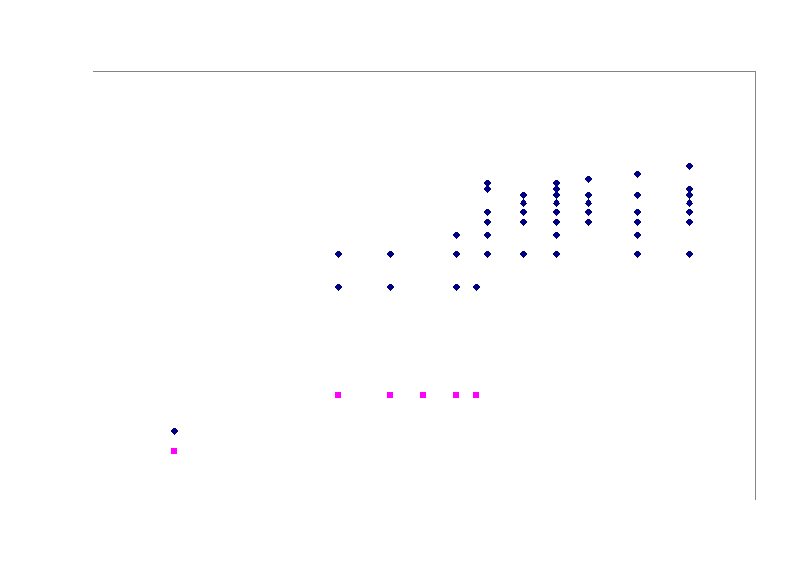
Mismatch SEUs were observed, starting at an LET of 37.2 MeV*cm2/mg. The cross section was negligibly higher when device Vcc was reduced to 4.5V from the typical of 5V. Figure 1 shows test data.
SEL was not observed on any test run, up to a maximum tested LET of 90.
V. SUMMARY
Due to the device’s LET threshold for SEU of 37.2, and its hardness to SEL, it is recommended for use in all spaceflight applications.
VI. ACKNOWLEDGEMENTS
Special thanks to the test team as well as to Hak Kim of Jackson & Tull for an excellent test setup.
Home
Last Revised: February 03, 2010
Digital Engineering Institute
Web Grunt: Richard Katz