Figures 1-7 are missing; I am trying to get them.
rk
tested 2/20-21/96
Version 1.0
Amy K. Moran
NASA/GSFC
(301)286-1412
and
Kenneth A. LaBel
NASA/GSFC
(301)286-9936
E-mail: Kenneth.A.LaBel@gsfc.nasa.gov
March 7, 1996
I. INTRODUCTION
The objective of this study was to determine the threshold linear energy transfers (LETths) and cross-sections for single event upset (SEU) and single event latchup (SEL) due to heavy ions. LETth is defined as the maximum LET at which no errors are seen at a fluence of 1.00E07 particles/cm2. SEU LETth is defined as the minimum LET value to cause an effect at a fluence of 1E7 particles/cm2. SEL LETth is defined as the maximum LET value at which no latchup occurs at a fluence of 1E7 particles/cm2. The saturation cross section of the device is the point at which the cross section curve becomes asymptotic.
II. TEST SAMPLES
Heavy ion single event effect (SEE) testing was performed at Brookhaven National Laboratories' twin Tandem van deGraaff accelerator on February 20-21, 1996 on the following 80386 microprocessors, 80387 Coprocessors, and 82380 Integrated Peripherals:
MFR     Device          Serial #    Date Code   Vcc   Project

Intel   MQ80386-25/B                9442        5     EOS-AM

SEI     H30466A-21      042, 044    9606        5     EOS-AM

Intel   MQ80387-20B                 9415        5     FUSE

Intel   MQ82380-25/B                9446        5     FUSE
The 80386 and 80387 are built on Intel's CHMOS IV process, while the 82380 is on the CHMOS III process. The SEI device is an Intel 80386 die repackaged by SEI into a RadPak(TM).
III. TEST TECHNIQUES AND SETUP
A. Facility Usage
Testing was performed at the Brookhaven National Laboratories (BNL) Single Event Upset Test Facility (SEUTF). This setup utilizes a dual Tandem Van De Graaff accelerator suitable for providing ions and energies for SEU testing. The test devices are mounted on a device-under-test (DUT) board inside a vacuum chamber.
The SEUTF uses a computer-driven monitor and control program to provide a user-friendly interface for running the experiments. Hard copies of the test data and graphs are also made available.
B. Test Hardware, Software and Control
The 80386, 80387, and 82380 devices were tested using a single-board computer. Custom software exercised the devices by performing memory accesses, addressing, data transfers, and numerical calculations.
C. Device Test Procedure
Reset: the device locks up, Icc remains at nominal operating level, and the condition is cleared by a reset signal (power is not cycled). Most likely the SEU, either alone or through propagation to the system, places the test device or a peripheral into an unknown state.
Lockup: the device locks up, Icc drops to a current indicative of standby operating mode, and the condition requires a power reset to recover. Most likely the SEU places the test device or a peripheral into an undefined, test, or standby mode. Test runs were halted upon lockup.
Microlatch: device Icc increases above normal operating level, but stays below the specified max for the device. A power reset is required to clear the condition.
SEUs in a test device may disrupt the system in numerous ways, causing the reset and lockup SEUs described above. For example, the 82380 is an integrated peripheral, performing DMA transfers, interrupt and timing generation, etc. An SEU in the 82380 may cause it to improperly generate an interrupt; while the cause is an 82380 SEU, the symptom will be an error on the 80386. Likewise, an SEU in the 80387 math coprocessor may cause it to return the wrong value for an 80386 calculation, sending the microprocessor, and therefore the system, into an undefined state.
Vcc and Vcc+/-5% were used for testing. Nominal Icc levels were:
Device          Icc typical (mA)   Icc max (mA) for SEL

MQ80386-25/B    134                680

H30466A-21      134                680

MQ80387-20B     60                 310

MQ82380-25/B    40                 375
Two to three samples, typically, were tested per device type.
Ions used for testing were:
Ion      Energy (MeV)   Linear Energy Transfer (LET)

                        in MeV*cm2/mg at normal incidence

F-19     140            3.38

Cl-35    188            12.0

Ni-58    280            26.2

Br-75    290            37.1

I-127    345            59.9
Energy and LET varied slightly among the three test dates. Intermediate LETs were achieved by varying the beam's angle of incidence to the package. Temperature was a nominal 25 deg C.
Fluxes: 7.2E2 to 2.6E4 particles /cm2/sec
Fluences: 1E6 particles /cm2
IV. TEST RESULTS AND DISCUSSION
All LETs are in MeV*cm2/mg.
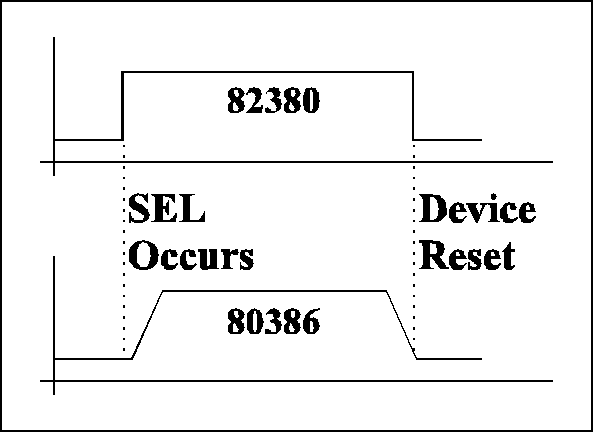
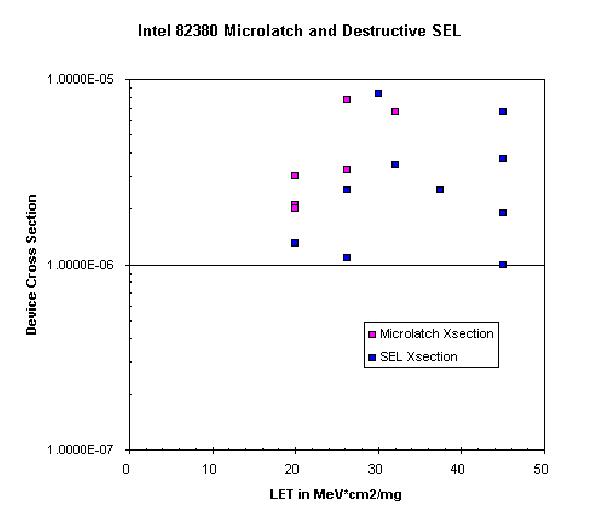
82380 SEL testing was complicated by the fact that the 82380 and 80386 currents were coupled; whenever the 82380 experienced SEL, the 80386 showed a corresponding increase in current, most likely due to a bus contention, as seen in the diagram to the right. Despite this coupling, a two-minute dwell test was performed. The 82380 and 80386 both recovered fully, following a power reset. Figure 11 displays both microlatch and SEL data.
V. SUMMARY
VI. ACKNOWLEDGEMENTS
Special thanks to the test team as well as to Doug Connelly of OSC for participating in the test.
Home
Last Revised: February 03, 2010
Digital Engineering Institute
Web Grunt: Richard Katz